Beyond the Postcard: How Sail Training Builds Aspiration in Cornwall’s Young People
Discover how Sail Training helps young people in Cornwall build confidence, aspiration, and opportunity. Inspired by The Pretty Poverty Report, this article explores how Morvargh Sailing Project works with schools like Brannel to tackle hidden rural depri
11 min read
Wednesday 8th of October 2025 Matt
Having recently read The Pretty Poverty Report, we were struck by how clearly it described the Cornwall we know and serve. At first glance, Cornwall’s landscapes tell a story of beauty and prosperity. The rolling coastline, open moors, and picture-postcard villages suggest a life of comfort and community. To many visitors, the region appears affluent; second homes overlook the sea, boutique shops sell artisan food and fine wines, and the tourism economy hums through the summer months.
Yet as The Pretty Poverty Report observes:
Behind the postcard-perfect image lies a more complex reality—one where too many local people face daily struggles with low pay, insecure housing, limited transport, and poor access to essential services. (Perran Moon)
In places such as St Dennis, Roche, Bugle, and Nanpean — the heart of Cornwall’s Clay Country that description feels painfully accurate. According to the Index of Multiple Deprivation (2021), several neighbourhoods in these communities are among the top 10% most deprived in England, facing persistent challenges including low wages, limited access to transport, and scarce local services.
The same report explains that:
Rural poverty tends to be more dispersed and hidden among relatively affluent populations, making it less visible to area-based measures designed for concentrated urban disadvantage.
The result is that deprivation exists beside visible prosperity; communities look successful from the outside, yet opportunity is often out of reach for those who live there.
For generations, the China clay industry has defined this region’s identity. At its height, Cornwall’s pits and processing works employed thousands and shaped every aspect of community life. But as industrialisation, automation, and global competition reshaped the sector, large-scale manual work was replaced by smaller numbers of specialist and technical roles. Job numbers fell from more than 13,000 in the mid-twentieth century to fewer than 1,000 today, marking a profound loss of stable employment and local security.
What remains is a legacy of generational unemployment and restricted opportunity, where young people often grow up without clear pathways into sustainable work. This contributes to lower levels of aspiration and a growing sense of disconnection.
It's within this context that Sail Training can make a tangible difference, offering young people experiences that rebuild confidence, spark ambition, and open horizons far beyond the limits of their postcode.
The Impact on Young People
Across the UK, young people are facing growing challenges to their well-being, confidence, and sense of purpose. The Education Policy Institute (report) found that personal well-being drops, on average, as children transition from primary to secondary school, and continues to decline as they progress through secondary school. The same study reports that self-esteem also falls sharply during adolescence.
The findings are particularly stark for those from lower-income families. The report shows that the lower a family’s income, the greater the impact on a young person’s wellbeing, confidence, and mental health. In simple terms, financial hardship and perceived inequality directly harm wellbeing, creating a cycle of disadvantage that can persist into adulthood.
These challenges are not abstract statistics for Cornwall. In the Clay Country, many young people grow up in families where work is uncertain or seasonal, and where long-term unemployment has become normalised over generations. Limited access to transport, affordable housing, and youth services adds to that pressure. The result is that aspiration can feel fragile, and the journey to employment or further education uncertain.
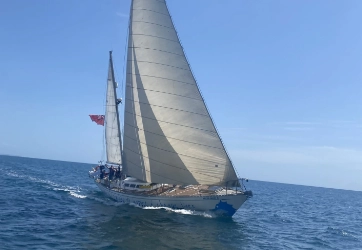
This is where Sail Training offers a unique and powerful response. Aboard Helen Mary R, young people are immersed in an environment that is both challenging and supportive. They learn to trust themselves and others, develop teamwork skills, and see tangible results from their efforts.
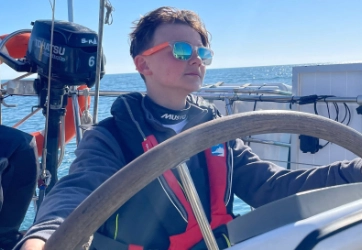
It starts from the moment they step on deck: the unfamiliar rhythm of the sea, the teamwork of hauling sails, and the quiet pride of taking the helm for the first time. Every sound and movement is shared; every success belongs to the crew. This lived experience builds self-esteem and resilience in ways that classroom interventions alone cannot achieve.
The parallels are clear. Where the Education Policy Institute calls for environments that strengthen wellbeing and confidence, Sail Training provides precisely that. Days at sea demand collaboration, perseverance, and leadership; they replace passivity with a sense of purpose. For young people whose communities may be limited by economic hardship or a lack of opportunities, Sail Training becomes a bridge, reconnecting them with their own potential and with a broader world of possibilities.
If adolescence is where wellbeing begins to falter, then it’s also where opportunity can rebuild it. Sail Training offers that opportunity, a place where learning happens not through instruction, but through experience.
Sail Training as a Bridge to Aspiration and Opportunity
Sail Training is a powerful developmental activity in which the sea and the vessel provide an environment that promotes self-discovery and growth through challenge, teamwork, and responsibility. The experience of working as a crew, often in unfamiliar and demanding conditions, develops confidence, communication, and leadership skills that are transferable to education, employment, and life.
This is what we see aboard Helen Mary R every season. For many young people from Cornwall’s rural and coastal communities, Sail Training is far more than an adventure; it is a turning point. Living and working as part of a crew requires collaboration, trust, and a strong sense of resilience. Each watch relies on every member, regardless of background or experience, to play their part. For those who may feel limited by circumstance, this environment offers something rarely found elsewhere: an equal footing and a chance to succeed through effort, not advantage.
Sail Training contributes to social inclusion by engaging young people who might not otherwise access developmental opportunities. This is especially relevant to communities where access to enrichment activities is often restricted by cost, transport, or awareness.
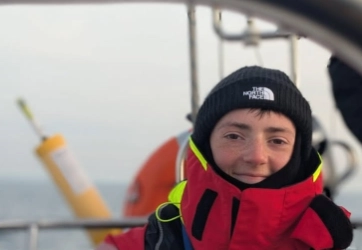
Through partnerships with Brannel School and the Cornwall Education Learning Trust, Morvargh is helping to bridge that gap. When students step aboard Helen Mary R, they are introduced to a world beyond the boundaries of their hometowns, one that shows them the value of teamwork, leadership, and perseverance. This short video, created by a teacher at Brannel School, highlights the impact that a Sail Training voyage has.
Participants consistently report that Sail Training helps them to recognise their own abilities. Participants describe a sense of achievement and self-belief that extends well beyond the voyage itself.
Moments like steering in bad weather or cooking together in a rolling galley often become the memories that shape confidence. Young people discover that their effort has a real impact, that courage and teamwork matter.
This trip was amazing for me it brought out so much in me that I never knew I could accomplish. I am so glad I did this trip. I have made some amazing friends and memories as well along the way.
That sense of self-belief is vital. In areas where generational unemployment and low aspiration have taken root, it helps young people imagine a different future for themselves and their communities.
Sail Training is not about producing sailors; it is about nurturing potential. A voyage at sea provides a living example of what can happen when young people are trusted, supported, and challenged. Each task, night watch, and shared meal becomes part of a journey toward confidence, independence, and a sense of purpose. The qualities gained: communication, resilience, empathy, and leadership, are the same ones young people need to thrive in education, work, and life.
The value of Sail Training lies in its ability to change attitudes and aspirations, building confidence in young people who may have lacked belief in their own potential. In this way, Sail Training becomes more than a voyage; it becomes a bridge linking experience with opportunity, and potential with purpose.
Working with Schools and Communities to Drive Change
Education should do more than prepare young people for exams; it should equip them for life. As we know, good health and well-being in adolescence are key to the development of emotional and cognitive skills, the completion of education, and the transition to employment. Yet too often, the social and emotional dimensions of learning are undervalued in areas where economic pressures dominate.
Schools such as Brannel School and others within Cornwall are at the heart of communities that reflect both the strengths and the struggles of rural Cornwall. Their commitment to broadening horizons aligns directly with the outcomes Sail Training delivers: confidence, teamwork, problem-solving, and leadership. These are not abstract ideals; they are practical, measurable skills recognised by employers and central to the Gatsby Benchmarks for good careers education.
Through our voyages, students experience firsthand what it means to take responsibility, to make decisions that matter, and to rely on one another to succeed. The challenges they face at sea mirror the difficulties of life ashore: uncertainty, perseverance, and the need for teamwork, but in an environment that empowers rather than intimidates.
The Pretty Poverty Report reminds us that community networks play a vital role in supporting residents. Morvargh’s Sail Training voyages extend this principle to young people. Each voyage builds a sense of belonging, not only to the crew but to a broader community of purpose, one that connects schools, families, and local organisations in shared belief that young people can achieve extraordinary things.
Our work complements what schools and youth services strive to do every day: to help young people recognise their potential and find the confidence to pursue it. The Characteristics and Value of the Sail Training Experience report concludes that “Sail Training builds the personal and social skills that underpin employability and lifelong learning”. It is this combination of challenge, support, and reflection that makes Sail Training such a powerful educational partner.
As the pressures of rural deprivation, mental health challenges, and limited opportunity continue to grow, projects like Morvargh show what can be achieved when education extends beyond the classroom. They demonstrate that with the right environment, young people from any background can thrive.
At Morvargh, we believe that every voyage aboard Helen Mary R is more than a sailing trip; it is an act of investment in potential. By working with schools, trusts, and community partners, we can ensure that young people from Cornwall’s most overlooked communities have access to opportunities that inspire, renew, and endure.
A Call to Action
The evidence is clear. From the Pretty Poverty Report to numerous other academic findings, young people growing up in rural and coastal communities face complex and often hidden barriers to opportunity. Low pay, limited opportunity, and the legacy of industrial decline have eroded confidence and aspiration, yet these are not barriers that must define their future.
Sail Training offers a way forward. It takes young people out of familiar settings and places them in an environment where effort, teamwork, and determination lead to success. It helps them to see themselves differently, not as limited by circumstance, but as capable, resilient, and full of potential.
At Morvargh, we have seen what happens when a young person takes the helm for the first time: the concentration, the nervous excitement, and then the unmistakable smile as the boat responds to their movements and they hold the course given. This is a moment of discovery, where they realise they can do more than they imagined. That transformation lies at the heart of our mission: to use Sail Training to Inspire and Change Lives.
We invite schools, trusts, and community partners to join us. Together, we can ensure that every young person in Cornwall, regardless of background, has the opportunity to experience the life-changing impact of Sail Training.
To find out how your school or organisation can get involved, contact us at hello@sailadventure.co.uk.
Discover your next adventure at sea. Join one of our life-changing Sail Training voyages and unlock confidence, teamwork,
and resilience through real experience.
Bring your skills aboard or ashore. From sailing staff to shore-based champions, volunteering changes lives — including your own.
Cookie preferences
We use privacy-friendly analytics to understand how people use our site. You can choose whether analytics cookies are
enabled for this browser. Read more in our privacy policy.